AI visibility checklist: 15 points to check on your website
Is your website ready for ChatGPT and AI? 15 concrete criteria to check, ranked by priority. No technical skills required.
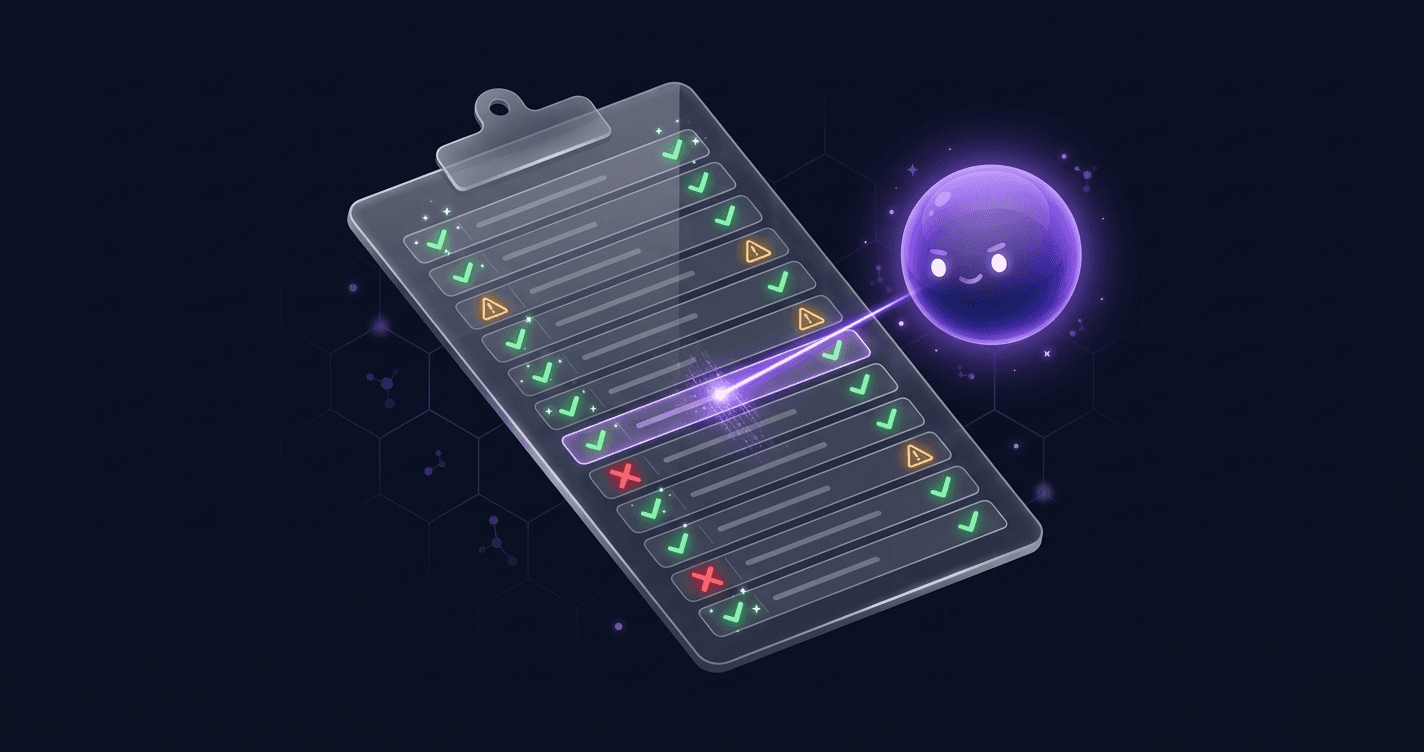
15 points, 3 categories, zero jargon
We compiled the 15 most important criteria for AI to cite your website. You don't need to be a developer to check most of them -- and for the technical ones, an automated diagnostic can do it for you.
Each section has a maximum score. Add up your points at the end to see where you stand.
Can AI read you? (5 points, max 25)
1. Your pages are accessible to AI robots
AI sends robots to read your site (GPTBot for ChatGPT, ClaudeBot for Claude, etc.). If your site blocks them, it's game over before it even starts.
Prevalence: About 35% of small business websites block at least one major AI robot without the owner knowing.
How to check: Go to yoursite.com/robots.txt in your browser. Look for lines that say "Disallow" next to names like GPTBot, ClaudeBot, or PerplexityBot. If you see them, your door is closed.
2. You have structured information in your code
These are invisible data points that describe your business in a format AI understands instantly. At minimum: who you are and what you do.
Prevalence: Only about 30% of small business sites have structured data beyond the basics. This is one of the biggest missed opportunities.
How to check: Use Google's Rich Results Test -- paste your URL. If the result says "No rich results detected," you're missing structured data.
3. Your code uses clear tags
Instead of stacking generic blocks, your site should use tags that say "this is an article," "this is navigation," "this is the main content." AI navigates these much better.
Prevalence: Around 45% of websites use modern, well-structured tags. The rest rely on generic code that AI struggles to parse.
How to check: Right-click on your page, select "View Page Source," and search for tags like <article>, <nav>, <main>. If you only see <div> everywhere, your site's structure could be clearer for AI.
4. You have an llms.txt file
A simple file that summarizes your site for AI. Few websites have one yet -- it's an advantage for those who set it up.
Prevalence: Under 5% of websites have this file. Early adopters gain a real edge.
How to check: Go to yoursite.com/llms.txt in your browser. If you get a "page not found" error, you don't have one.
5. Your site is secure and fast
HTTPS and a reasonable loading time. The basics -- but essential ones. A slow or insecure site loses points everywhere, with Google and AI alike.
Prevalence: About 85% of sites now use HTTPS, but only around 50% load in under 3 seconds.
How to check: Does your URL start with https://? For speed, use Google PageSpeed Insights -- aim for a score above 50 on mobile.
Does AI trust you? (5 points, max 25)
6. Someone signed your content
AI ignores anonymous content. Even a simple "By [Your Company Name]" makes a difference.
Prevalence: Roughly 60% of small business websites have no author attribution on their main content pages.
How to check: Look at your homepage and your most important pages. Is there a visible author name or company name? If not, add one.
7. Your content is dated
Publication date and update date. Undated content is suspicious to AI. A 3-year-old article with no updates will be ignored.
Prevalence: About 40% of business website pages have no visible date at all.
How to check: Look at your blog posts, service pages, and key content pages. Can you see when each was published or last updated?
8. You cite your sources
When you make a claim, you back it up. A link to a study, an official report, a recognized organization. AI checks -- and prefers sites that source their claims.
Prevalence: Under 20% of small business sites cite external sources in their content.
How to check: Read through your top pages. When you state a fact or statistic, is there a link to where it came from? If all your claims are unsourced, AI treats them as opinions.
9. You have concrete numbers
Not "many clients trust us" but "200 companies have trusted us since 2015." AI looks for tangible evidence.
Prevalence: About 70% of business sites use vague language ("many," "most," "leading") instead of specific figures.
How to check: Search your own site for words like "many," "several," "most." Each one is a chance to replace with a real number.
10. Your content answers specific questions
AI loves the Q&A format. If your subheadings are questions and the paragraph below answers them in a few lines, you maximize your chances of being cited.
Prevalence: Under 25% of business sites structure their content as Q&A.
How to check: Look at your page headings. Are they descriptive labels ("Our Services") or actual questions ("What services do we offer?")? The second format gets cited far more often.
Do others talk about you? (5 points, max 25)
11. You have social media profiles
Facebook, LinkedIn, Instagram -- at least one or two. AI checks that you exist outside your own website.
Prevalence: Most businesses have social profiles, but about 30% don't link to them from their website, making it hard for AI to connect the dots.
How to check: Are your social media links visible on your website? Can AI follow them to verify your presence?
12. You have reviews or testimonials
Visible customer reviews on your site, ideally with names and specific details. AI cites businesses with social proof more easily.
Prevalence: Only about 35% of small business sites display customer reviews or testimonials on their homepage.
How to check: Do you have customer quotes visible on your site? Are they attributed to real people with names and details, or are they generic and anonymous?
13. Your contact info is complete
Email, phone, address -- at least two or three. A business with no contact details looks suspicious to humans AND to AI.
Prevalence: Roughly 25% of business websites are missing at least one key piece of contact information.
How to check: Can a visitor find your email, phone number, and physical address without digging? Is this information consistent across your site?
14. Your brand is consistent
Your name is the same everywhere: on your site, in your structured data, on your social media. You have a visible logo and an "About" page.
Prevalence: About 40% of businesses have inconsistencies in their name or branding across different platforms.
How to check: Search your company name on Google. Do all results show the exact same name? Check your social media profiles, directory listings, and website footer.
15. You exist beyond your website
Mentions in directories, articles, partners who talk about you. AI doesn't rely solely on what you say about yourself -- it verifies.
Prevalence: Around 50% of small businesses have fewer than 3 external mentions or directory listings that AI can find.
How to check: Google your business name in quotes (e.g., "Your Business Name"). Count how many results come from sites other than your own. Fewer than five? You need more external presence.
Count your points
Section 1 -- Can AI read you? ___ / 25
Section 2 -- Does AI trust you? ___ / 25
Section 3 -- Do others talk about you? ___ / 25
Total: ___ / 75
What your score means
- 55-75 -- Your site is well-prepared. AI has what it needs to cite you. Focus on maintaining and refining.
- 35-54 -- You have the basics, but important signals are missing. Prioritize the sections where you scored lowest.
- 0-34 -- Your site is probably invisible to ChatGPT. There's work to do, but every point gained counts. Start with Section 1 (making sure AI can read you) -- it has the highest impact.
For an automated, personalized diagnostic, TryGEO checks these criteria (and more) in 30 seconds on your homepage. It tells you not just what's missing, but where to start first.
Check your visibility for free
Full diagnostic of your homepage in 30 seconds — free, no signup.
Test my siteRelated articles

Alexandre Aumont
Founder of TryGEO. Passionate about the web, artificial intelligence and chess.
March 6, 2026 · Updated on March 30, 2026