Google AI Overviews: what impact on your visibility?
Google now shows AI-generated answers at the top of search results. Who gets cited, who disappears, and how to stay visible: the complete guide.
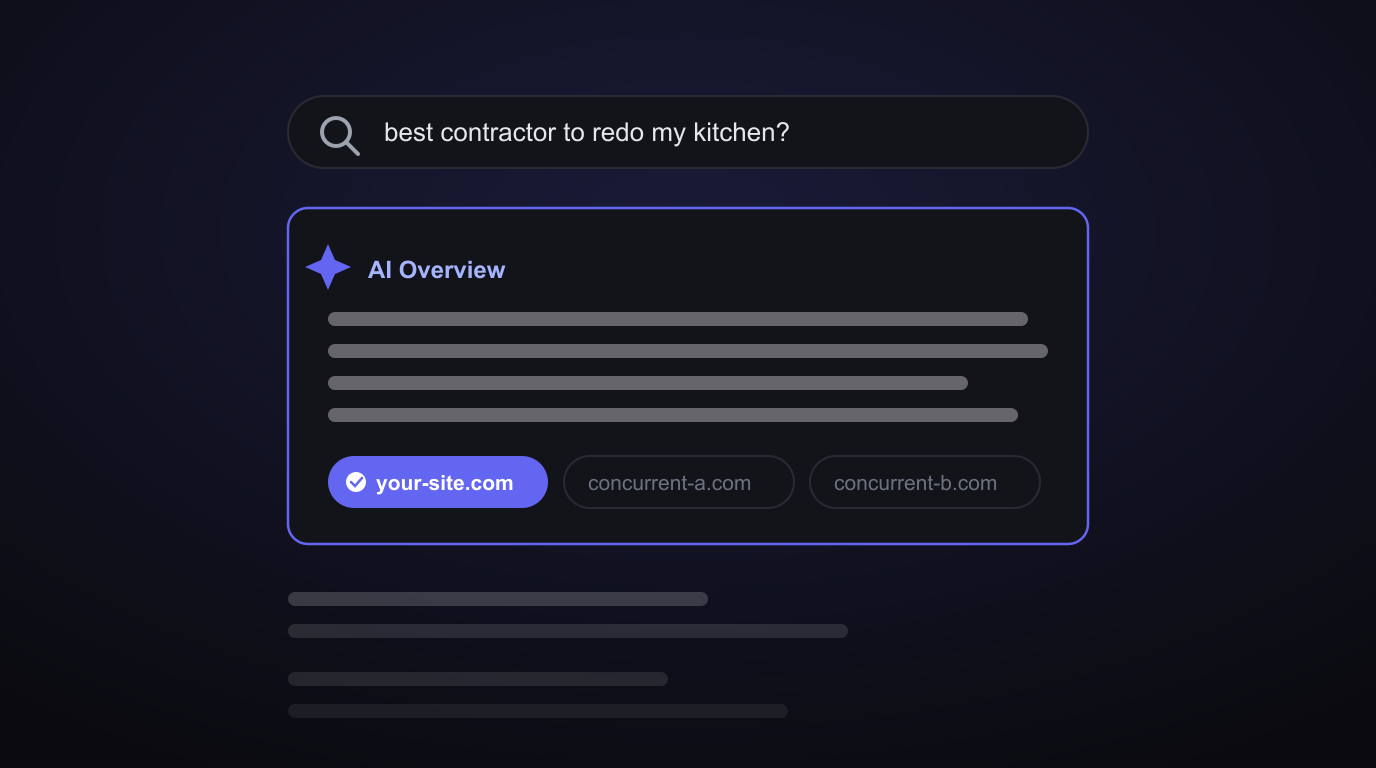
Google no longer shows ten blue links
Try it yourself: ask Google a question like "how to choose an accountant" or "how much does a bathroom renovation cost". More and more often, the first thing you see is no longer a list of links -- it's a paragraph written by Google's artificial intelligence, with a handful of cited sources on the side.
That block is called AI Overviews. It mostly appears on question-shaped queries: "how", "why", "what's the best", "how much does it cost". Exactly the kind of questions your future customers ask before buying.
The change is brutal for one simple reason: when Google answers directly, part of your visitors never click the classic links anymore. The answer is already right there.
Who wins, who loses
You might think everyone loses. That's wrong. AI Overviews splits websites into two categories:
Sites cited inside the AI overview. Their link appears directly in the answer block, at the very top of the page, before the classic results. These sites get fewer "curious" clicks, but more qualified visitors: people who read the answer, saw the source, and want to know more. A visitor who lands on your site from an AI overview already knows why they came.
Sites absent from the overview. They suffer twice: they get pushed down visually (the AI block fills the whole screen on mobile), and they lose the clicks of visitors satisfied by the answer. A site ranked first in the classic results can end up, in practice, below the fold.
So the question is no longer just "do I rank well on Google?" but "am I cited when Google writes its answer?".
How Google picks the sources it cites
Google doesn't publish its exact recipe, but observing thousands of AI overviews reveals consistent patterns. Cited sources almost always share these traits:
- They answer the question directly. A paragraph that starts with the answer ("An accountant charges between X and Y euros per month for a small business") is far more likely to be picked up than text that circles the topic for three paragraphs.
- They are structured. Clear question-shaped headings, lists, comparison tables: everything that helps the AI cut your content into reusable units.
- They are credible. Identified author, visible publication date, a real business with a consistent online presence. Google cross-checks these signals before citing a source in an answer it signs with its own name.
- They are technically accessible. If your page content isn't readable by Google's crawlers -- because it loads late or your site is too slow -- you don't exist for the AI overview.
You'll notice these are the same criteria ChatGPT and Perplexity use to pick their sources. That's no coincidence: we covered this mechanism in detail in What is GEO?
Are you affected? Test it in 2 minutes
Not every search triggers an AI overview. Navigation queries ("city pool opening hours") or direct purchase queries ("cheap iphone 16") rarely show one. But queries that precede a decision trigger them more and more:
- "how to choose a [your profession]"
- "how much does [your service] cost"
- "[your service]: what you need to know"
- "best [your product] for [need]"
Take the 3 questions your customers ask you most often on the phone. Type them into Google. If an AI overview shows up: who is cited? You, or your competitors? If it's a competitor, everyone asking that question is now reading their answer -- not yours.
5 concrete actions to get cited
The good news: unlike classic SEO where positions take years to earn, AI overviews reshuffle the deck. Modest but well-structured sites get cited ahead of giants. Here's where to start:
-
Answer real questions, one sentence first. For each frequent customer question, create a section whose heading is the question and whose first paragraph is the complete answer. Details come after.
-
Add an FAQ to your main pages. It's the AI's favorite format: one question, one self-contained answer of 100 to 150 words. Not three vague lines, not two pages of digression.
-
Sign and date your content. A name, a photo, an update date. Google cites sources, not anonymous pages.
-
Make sure your site is readable by crawlers. Content present as soon as the page loads, decent speed, no crawler blocking. Invisible to you, decisive for the AI.
-
Take care of what's said about you elsewhere. Google reviews, directory mentions, consistent business information: Google cross-checks everything before citing a source. Your reputation weighs on your citability, as we explain in our article on online reputation.
What TryGEO actually measures
You can't fix what you can't see. TryGEO analyzes your site on the criteria that determine your presence in AI answers -- Google's as well as ChatGPT's:
- Are your pages accessible to Google's and AI crawlers?
- Is your content cut into reusable answers or indigestible blocks?
- Do your pages carry the credibility signals Google requires before citing a source?
- Does your online reputation confirm what your site claims?
Each criterion is scored, explained, and comes with the steps to fix it.
Take action
AI Overviews is not an experiment: it's Google's new homepage. Every month, a growing share of your potential customers reads an AI-written answer instead of browsing links.
Three things to do this week:
- Test your 3 customer questions on Google and note who gets cited in the AI overviews
- Rewrite your main page so it answers the most frequent question in the very first paragraph
- Add an FAQ with complete, self-contained answers
Run your free diagnostic on TryGEO to find out in 30 seconds whether your site has what it takes to be cited -- by Google and by ChatGPT.
Check your visibility for free
Full diagnostic of your homepage in 30 seconds — free, no signup.
Test my siteRelated articles

Alexandre Aumont
Founder of TryGEO. Passionate about the web, artificial intelligence and chess.
July 17, 2026