Is Your Content Good Enough for Google and AI?
Google and ChatGPT analyze your content quality: readability, depth, structure. If your text is shallow, you're invisible.
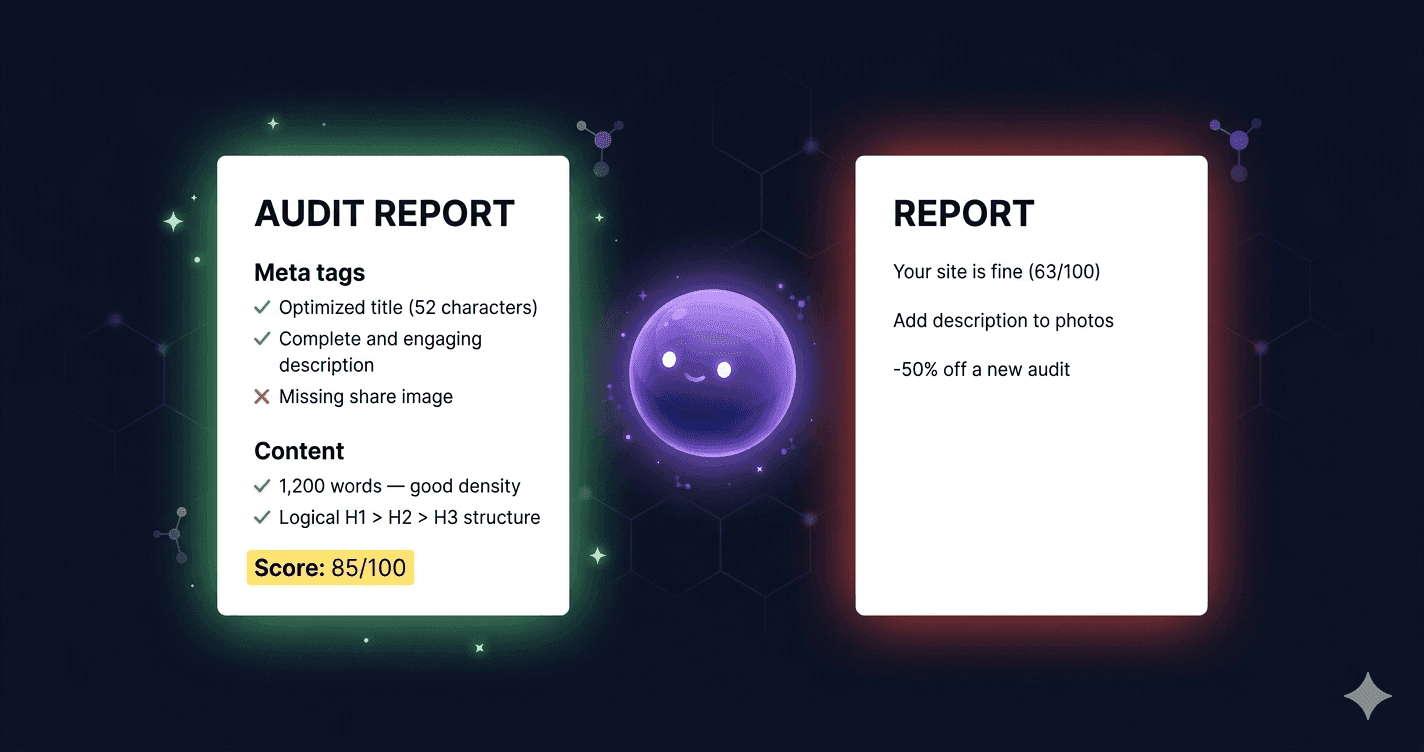
The harsh truth about "good enough" content
You spent an afternoon writing your website copy. You described your services, added a few photos, maybe even wrote a blog post or two. You hit publish and waited for the customers to roll in.
They didn't.
Here's why: Google and AI don't just look at whether your page has words on it. They evaluate the quality of those words. How clear they are. How deep they go. How well they're structured. And if your content doesn't meet their standards, it's as though your page doesn't exist.
This isn't about writing literary masterpieces. It's about understanding what "quality" actually means to the algorithms that decide who gets found online.
What a bakery in London taught us about content
Let's say you run a bakery in Camden. Your "About" page reads:
"We are a bakery in Camden. We sell bread, cakes, and pastries. We use fresh ingredients. Come visit us!"
Four sentences. Technically accurate. And completely invisible to both Google and ChatGPT.
Now consider this version:
"Since 2018, our Camden bakery has been baking sourdough with a 72-hour cold fermentation process. We source organic flour from a mill in Kent and use no commercial yeast. Every morning at 5am, our bakers shape around 200 loaves by hand — and most are sold before noon."
Same bakery. But the second version does three things the first one doesn't: it provides specific details, it demonstrates genuine expertise, and it gives the reader a reason to care.
Google notices this difference. So does ChatGPT when it's deciding which bakery to recommend.
Why Google cares about your content quality
Google's entire business depends on showing people useful results. If someone searches for "best bakery in Camden" and Google sends them to a page with four generic sentences, that person stops trusting Google. So Google has become exceptionally good at distinguishing shallow content from genuinely helpful content.
Here's what Google evaluates, in plain terms:
Does your page actually answer the question?
When someone searches "how to choose a wedding cake," Google wants to show a page that walks them through the process: flavours, sizing for guest counts, tasting appointments, delivery logistics. If your page just says "We make beautiful wedding cakes, contact us for details," you haven't answered the question. Google knows this and ranks you lower.
Is the information original or just recycled?
Google can tell when your content is a slightly reworded version of what ten other websites already say. If every florist in Bristol writes "We offer beautiful bouquets for all occasions," nobody stands out. The florist who writes about how they source peonies from a specific grower in the Cotswolds, or explains why certain flowers last longer in warm offices — that's the one Google rewards.
Is it written for humans or for search engines?
There was a time when stuffing your page with keywords worked. Those days are long gone. Google now penalises content that reads like it was written for a robot. If your plumbing page says "plumber in Manchester, Manchester plumber, best plumber Manchester" five times in the first paragraph, Google doesn't just ignore it — it actively pushes you down.
Is there enough depth?
A 100-word page about kitchen renovations won't compete with a 1,500-word guide that covers planning, budgets, timelines, material choices, and common mistakes. Google uses depth as a signal of expertise. This doesn't mean you need to write a novel, but you do need to cover a topic thoroughly enough to be genuinely useful.
What AI looks for (and it's slightly different)
ChatGPT, Perplexity, and Google's AI Overviews are newer players, but they're already shaping how people find businesses. And they evaluate content with a slightly different lens.
Clear, quotable statements
AI models love content they can extract and cite. When your page includes a clear statement like "Our average kitchen renovation takes 6 to 8 weeks and costs between 15,000 and 25,000 pounds," that's easy for ChatGPT to pick up and include in an answer.
Vague content like "We complete renovations in a timely manner at competitive prices" gives AI nothing to work with. There's no fact to cite, no number to reference, no specificity to build on.
Structured information
AI parses content more effectively when it's well-organised. If you run an accounting firm and your services page uses clear headings — "Self-Assessment Tax Returns," "VAT Registration," "Annual Accounts for Limited Companies" — AI can quickly identify what you offer and match it to user questions.
A wall of unbroken text about "all our accounting services" makes it harder for AI to extract relevant information. Not impossible, but harder. And when AI has to choose between your page and a better-structured competitor, it picks the competitor.
Demonstrated expertise
AI models are trained to favour content that shows real knowledge. A personal trainer who writes "Compound movements like squats and deadlifts build more muscle than isolation exercises because they recruit multiple muscle groups and trigger a greater hormonal response" demonstrates expertise that AI can trust and cite.
A page that says "We help you get fit with our amazing training programmes" demonstrates nothing. It's marketing fluff, and both Google and AI can spot it instantly.
The readability factor most people ignore
Here's something that surprises many business owners: the readability of your content directly affects your visibility.
If your sentences average 35 words, if you use passive voice constantly, if your paragraphs go on for 200 words without a break — both Google and AI penalise you. Not because they're grammar teachers, but because hard-to-read content is less useful to the people they're trying to serve.
What good readability looks like:
- Sentences average 15 to 20 words
- Paragraphs are 3 to 5 sentences maximum
- You use active voice most of the time ("We deliver flowers" not "Flowers are delivered by us")
- Technical terms are explained when necessary
- Subheadings break up the text every 200 to 300 words
Think about it from your own experience. When you land on a page and see a massive wall of text with no headings, no spacing, and sentences that run on forever — you hit the back button. Google tracks this behaviour. When visitors leave quickly, it signals that the content isn't serving its purpose.
The structure that Google and AI both reward
Good content isn't just well-written. It's well-organised. Here's the structure that consistently performs well for both traditional search and AI:
Start with what people want to know
Your opening paragraph should immediately tell the reader what they'll learn or get from the page. Don't start with your company history. Don't start with "Welcome to our website." Start with the value.
For a plumber: "A dripping tap wastes up to 5,500 litres of water per year and can cost you over 100 pounds on your bill. Here's how to know when it's time to call a professional."
Use headings that describe what follows
"Our Services" tells the reader nothing. "Emergency Plumbing, Boiler Repairs, and Bathroom Installations" tells them exactly what to expect. Good headings serve two purposes: they help readers scan the page quickly, and they help Google and AI understand the content structure.
Include specific details and numbers
Every industry has specifics that demonstrate expertise:
- A removals company: "We completed 1,200 house moves across Greater London last year"
- A dentist: "A standard teeth whitening session takes about 60 minutes and results last 6 to 12 months"
- A solicitor: "The average conveyancing process takes 8 to 12 weeks from offer acceptance to completion"
These details are what AI extracts and cites. They're what make Google trust your page enough to rank it highly.
End with a clear next step
Every page should tell the reader what to do next. "Book a free consultation," "Download our pricing guide," "Call us for an estimate." This isn't just good marketing — Google actually evaluates whether your page fulfils the user's intent, and a clear call to action is part of that.
Common mistakes that kill your content quality
After analysing thousands of websites, we see the same content problems repeatedly:
Mistake 1: Writing for yourself instead of your customer. Your customer doesn't care that you've been "passionate about gardening since childhood." They care whether you can make their garden look good before their summer party. Lead with their problem, not your story.
Mistake 2: Being vague when you could be specific. "Competitive prices" means nothing. "Kitchen installations starting from 8,000 pounds" means something. Every vague phrase is a missed opportunity to demonstrate expertise and give AI something to cite.
Mistake 3: Duplicating content across pages. If your "Residential Plumbing" and "Commercial Plumbing" pages are 80 percent identical with just a few words swapped, Google treats this as duplicate content and may ignore both. Each page needs genuinely unique, valuable information.
Mistake 4: Ignoring updates. A blog post from 2019 about "this year's kitchen trends" actively hurts your credibility. If you can't commit to updating content, add evergreen information that doesn't go stale. "How to maintain your worktops" ages better than "2019's hottest countertop colours."
Mistake 5: No internal context. Your "Bathroom Renovations" page should link to your "Tiling Services" page, your "Gallery" page, and your "Contact" page. These connections help Google understand the breadth of your expertise and help AI map the relationships between your services.
How to check your own content quality
You don't need to be an expert to assess whether your content is strong enough. Ask yourself these five questions about each important page on your site:
- If I were a customer, would this page answer my question? Not partially. Fully.
- Does this page say anything my competitors don't? If not, why would Google choose you over them?
- Can I find at least three specific facts or numbers on this page? Details are the currency of credibility.
- Is the text easy to read without concentrating hard? If you have to re-read a sentence to understand it, rewrite it.
- When was this page last updated? If it's been more than a year, it's probably time.
Content quality is a business decision, not just a writing task
Many business owners think of their website content as a one-time task: write it, publish it, move on. But the reality in 2026 is that your content quality directly determines how many customers find you.
A well-written, well-structured page about your services doesn't just rank higher on Google. It gets cited by ChatGPT when someone asks for a recommendation. It gets referenced by Perplexity when someone researches their options. It becomes the foundation of your entire online presence.
The businesses that understand this — and invest even a few hours per month in improving their content — are the ones pulling ahead. The ones still running on generic copy from 2020 are wondering why their phone stopped ringing.
See how your content measures up
TryGEO analyses your content quality across every page of your site. It checks readability, depth, structure, and whether your content is strong enough to get cited by AI.
In less than a minute, you'll know exactly where your content stands — and what to improve first.
Check your visibility for free
Full diagnostic of your homepage in 30 seconds — free, no signup.
Test my siteRelated articles

Alexandre Aumont
Founder of TryGEO. Passionate about the web, artificial intelligence and chess.
March 24, 2026